


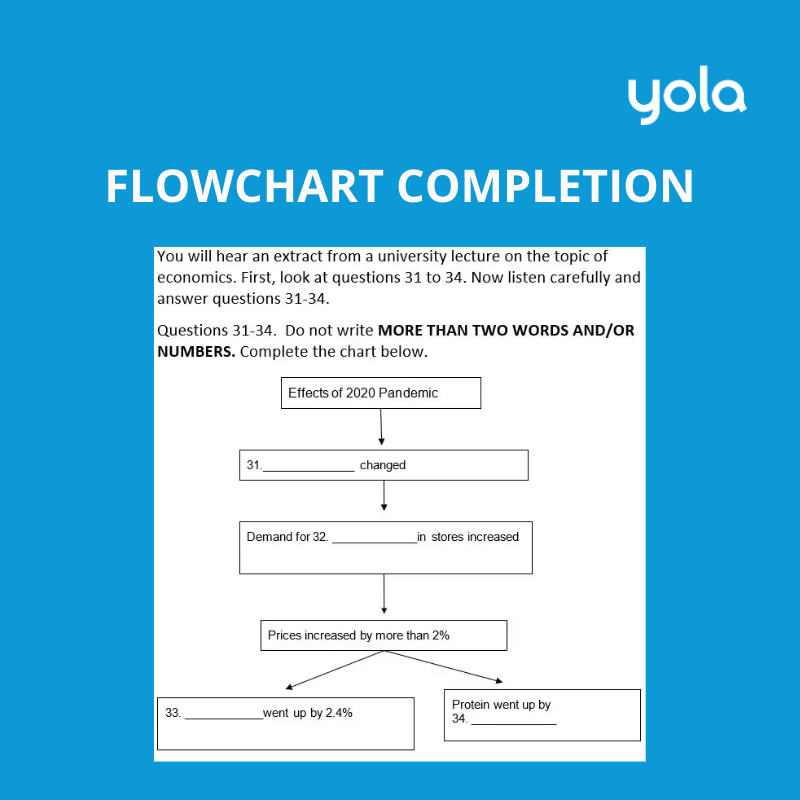
Trong bài thi IELTS Reading, dạng Flowchart Completion thuộc nhóm câu hỏi điền từ vào sơ đồ. Đây là dạng bài yêu cầu thí sinh hoàn thành một biểu đồ mô tả quy trình, chuỗi sự kiện hoặc các bước diễn ra theo thứ tự thời gian hoặc logic bằng cách lấy từ khóa từ bài đọc và điền vào các chỗ trống trong flowchart.
Dạng bài này xuất hiện khá phổ biến trong IELTS Academic Reading, đặc biệt trong các bài miêu tả quy trình khảo cổ, thí nghiệm khoa học, công nghệ và lịch sử. Nếu nắm vững phương pháp làm bài, bạn có thể tiết kiệm thời gian và nâng cao độ chính xác đáng kể.
1. Flowchart Completion là gì?
Flowchart Completion là dạng câu hỏi yêu cầu thí sinh điền đúng một từ hoặc cụm từ theo quy định từ bài đọc vào sơ đồ tóm tắt. Biểu đồ này thể hiện các bước tiến trình, giai đoạn phát triển, hoặc chuỗi sự kiện, được sắp xếp theo một trình tự nhất định.
Thí sinh phải:
- Xác định đúng vị trí thông tin trong bài đọc
- Chọn từ chính xác đang có trong bài viết (không tự diễn đạt lại)
- Đảm bảo đáp án đúng số từ theo yêu cầu đề bài
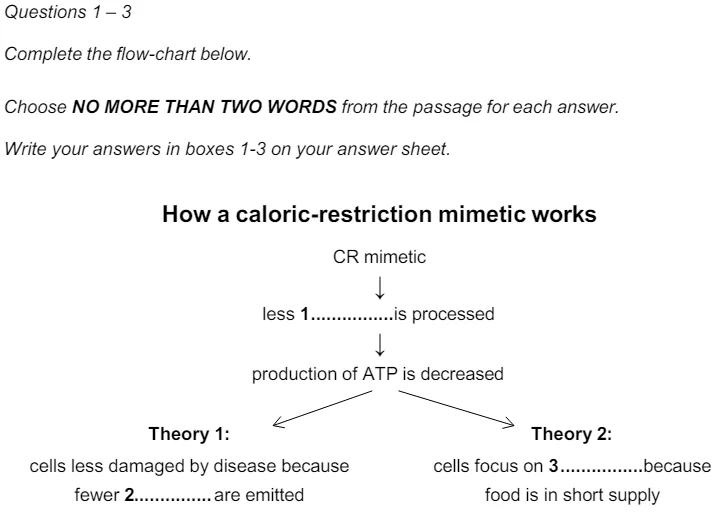
2. Các bước làm dạng bài Flowchart Completion trong IELTS Reading
Bước 1: Đọc kỹ yêu cầu và giới hạn từ
Kiểm tra đề yêu cầu ONE WORD ONLY, NO MORE THAN TWO WORDS hay một giới hạn khác.
→ Đáp án đúng ý nghĩa nhưng sai số từ vẫn bị tính sai.
Bước 2: Phân tích flowchart và xác định từ khóa
Đọc nhanh toàn bộ sơ đồ và gạch chân các yếu tố chính:
- Sự vật / sự kiện
- Mốc thời gian
- Địa điểm
- Các động từ chính thể hiện hành động
Điều này giúp bạn định hướng chính xác đoạn văn chứa thông tin cần tìm.
Bước 3: Đọc lướt bài và khoanh vùng đoạn văn
Dùng kỹ năng scanning để tìm từ khóa đã xác định.
Tránh đọc toàn bài theo thứ tự vì tốn thời gian.
Bước 4: Chọn từ đúng từ bài đọc và điền vào chỗ trống
- Đảm bảo phù hợp ngữ pháp và ngữ nghĩa
- Lấy đúng từ trong bài (không paraphrase)
- Kiểm tra số từ theo yêu cầu
Sau khi tìm được đoạn văn có chứa thông tin cần thiết, bạn cần chọn từ chính xác từ bài đọc và điền vào chỗ trống sao cho phù hợp với ngữ pháp và ngữ nghĩa của câu. Dưới đây là phân tích đáp án cho câu 1:
1992 – the boat was discovered during the construction of a ………….. 1992
Từ bước 3, chúng ta xác định được đoạn văn sau phù hợp với câu hỏi này:
It was 1992. In England, workmen were building a new road through the heart of Dover, to connect the ancient port and the Channel Tunnel, which, when it opened just two years later, was to be the first land link between Britain and Europe for over 10,000 years. A small team from the Canterbury Archaeological Trust (CAT) worked alongside the workmen, recording new discoveries brought to light by the machines.
Trong đoạn văn này, chúng ta thấy được từ đồng nghĩa hoặc parallel expression với construction là building, và của discovered là discoveries. Chúng ta cần tìm một thứ được xây dựng → một con đường (building a new road).
Bước 5: Kiểm tra lại đáp án
- Kiểm tra chính tả
- Kiểm tra giới hạn từ
- Kiểm tra logic theo sơ đồ
3. Những lỗi thường gặp khi làm dạng Flowchart Completion
| Lỗi phổ biến | Nguyên nhân |
| Điền sai số từ | Không đọc kỹ yêu cầu |
| Tự diễn đạt lại từ bài đọc | Thiếu chú ý yêu cầu dùng chính xác từ |
| Tìm sai đoạn văn | Bỏ qua từ khóa quan trọng |
| Không kiểm tra lại đáp án | Mắc lỗi ngữ pháp, chính tả, số từ |
4. Tips để làm bài Flowchart Completion hiệu quả
- Luôn bắt đầu bằng việc đọc yêu cầu số từ
- Dùng kỹ năng scanning theo từ khóa
- Gạch chân động từ và mốc thời gian trong sơ đồ
- Đừng cố hiểu toàn bài – chỉ tập trung vào phần liên quan
- Ưu tiên tính chính xác hơn tốc độ
5. Bài tập Flow Chart IELTS Reading
Chúng ta hãy cùng nhau giải quyết phần còn lại của bài Flow-chart Completion trong bài đọc The Dover Bronze-Age Boat nhé.
THE DOVER BRONZE-AGE BOAT
It was 1992. In England, workmen were building a new road (Q1) through the heart of Dover, to connect the ancient port and the Channel Tunnel, which, when it opened just two years later, was to be the first land link between Britain and Europe for over 10,000 years. A small team from the Canterbury Archaeological Trust (CAT) worked alongside the workmen, recording new discoveries brought to light by the machines.
At the base of the deep shaft six meters below the modern streets, a wooden structure was revealed (Q10). Cleaning away the waterlogged site overlying the timbers, archaeologists realized its true nature. They had found a prehistoric boat, preserved by the type of sediment in which it was buried. It was then named the Dover Bronze-Age Boat.
About nine meters of the boat’s length was recovered; one end lay beyond the excavation and had to be left. What survived consisted essentially of four intricately carved oak planks: two on the bottom, joined along a central seam by a complicated system of wedges and stitched to the others. The seams had been made watertight by pads of moss (Q11), fixed by wedges and yew stitches.
The timbers that closed the recovered end of the boat had been removed in antiquity when it was abandoned, but much about its original shape could be deduced. There was also evidence for missing upper side planks. The boat was not a wreck, but had been deliberately discarded, dismantled and broken (Q6). Perhaps it had been “ritually killed” at the end of its life, like other Bronze-Age objects.
With hindsight, it was significant that the boat was found and studied by mainstream archaeologists who naturally focused on its cultural context (Q7). At the time, ancient boats were often considered only from a narrower technological perspective, but news about the Dover boat reached a broad audience. In 2002, on the tenth anniversary of the discovery, the Dover Bronze-Age Boat Trust hosted a conference (Q2), where this meeting of different traditions became apparent. Alongside technical papers about the boat, other speakers explored its social and economic contexts, and the religious perceptions of boats in Bronze- Age societies. Many speakers came from overseas, and debate about cultural connections was renewed.
Within seven years of excavation, the Dover boat had been conserved and displayed, but it was apparent that there were issues that could not be resolved simply by studying the old wood. Experimental archaeology seemed to be the solution: a boat reconstruction, half-scale or full- sized, would permit assessment of the different hypotheses regarding its build and the missing end. The possibility of returning to Dover to search for a boat’s unexcavated northern end was explored, but practical and financial difficulties were insurmountable – and there was no guarantee that the timbers had survived the previous decade in the changed environment (Q8).
Detailed proposals to reconstruct the boat were drawn up in 2004 (Q3). Archaeological evidence was beginning to suggest a Bronze- Age community straddling the Channel, brought together by the sea, rather than separated by it. In a region today divided by languages and borders, archaeologists had a duty to inform the general public about their common cultural heritage.
The boat project began in England but it was conceived from the start as a European collaboration. Reconstruction was only part of a scheme that would include a major exhibition and an extensive educational and outreach program. Discussions began early in 2005 with archaeological bodies, universities and heritage organizations either side of the Channel. There was much enthusiasm and support, and an official launch of the project was held at an international seminar in France in 2007 (Q4). Financial support was confirmed in 2008 and the project then named BOAT 1550BC got under way in June 2011.
A small team began to make the boat at the start of 2012 on the Roman Lawn outside Dover museum. A full-scale reconstruction of a mid-section had been made in 1996, primarily to see how Bronze- Age replica tools performed. In 2012, however, the hull shape was at the centre of the work (Q12), so modern power tools were used to carve the oak planks, before turning to prehistoric tools for finishing. It was decided to make the replica haft-scale for reasons of cost and time (Q13), any synthetic materials were used for the stitching, owing to doubts about the scaling and tight timetable.
Meanwhile, the exhibition was being prepared ready for opening in July 2012 at the Castle Museum in Boulogne-sur-Mer (Q5). Entitled ‘Beyond the Horizon: Societies of the Channel & North Sea 3,500 years ago’ it brought together for the first time a remarkable collection of Bronze- Age objects, including many new discoveries for commercial archaeology and some of the great treasure of the past. The reconstructed boat, as a symbol of the maritime connections that bound together the communities either side of the Channel, was the centrepiece.
ĐÁP ÁN:
road
Đoạn 1: It was 1992. In England, workmen were building a new road through the heart of Dover, to connect the ancient port and the Channel Tunnel, which, when it opened just two years later, was to be the first land link between Britain and Europe for over 10,000 years. A small team from the Canterbury Archaeological Trust (CAT) worked alongside the workmen, recording new discoveries brought to light by the machines.
→ Từ khóa: 1992, building, discoveries conference
Đoạn 5: In 2002, on the tenth anniversary of the discovery, the Dover Bronze-Age Boat Trust hosted a conference, where this meeting of different traditions became apparent.
→ Từ khóa: 2002, hosted proposals
Đoạn 7: Detailed proposals to reconstruct the boat were drawn up in 2004. Archaeological evidence was beginning to suggest a Bronze- Age community straddling the Channel, brought together by the sea, rather than separated by it.
→ Từ khóa: 2004, reconstruct, drawn up launch
Đoạn 8: There was much enthusiasm and support, and an official launch of the project was held at an international seminar in France in 2007.
→ Từ khóa: 2007, was held exhibition
Đoạn cuối: Meanwhile, the exhibition was being prepared ready for opening in July 2012 at the Castle Museum in Boulogne-sur-Mer. Entitled ‘Beyond the Horizon: Societies of the Channel & North Sea 3,500 years ago’ it brought together for the first time a remarkable collection of Bronze- Age objects, including many new discoveries for commercial archaeology and some of the great treasures of the past.
→ Từ khóa: 2012, a remarkable collection, objects
Tìm hiểu thêm:
- Cách làm dạng bài Summary Completion Questions trong IELTS Reading
- Các dạng bài Reading IELTS phổ biến
5. Kết luận
Flowchart Completion là dạng bài không quá khó nếu biết cách phân tích từ khóa và khoanh vùng đoạn văn chính xác. Việc luyện tập thường xuyên sẽ giúp bạn cải thiện tốc độ xử lý thông tin và tăng độ chính xác trong phòng thi.

 30/06/2026
SỰ KIỆN MIỄN PHÍ DÀNH RIÊNG CHO CÁC FOOD LOVERS: Thưởng thức ẩm thực, tự tin giao tiếp tiếng Anh
YOLA Food Fair là sự kiện miễn phí dành cho các bạn yêu thích ẩm thực và mong muốn thực hành tiếng Anh trong một không gian gần gũi, vui vẻ và nhiều trải nghiệm tương tác. Tại sự kiện, học viên có thể mang món ăn yêu thích đến YOLA, cùng bạn bè thưởng […]
 27/01/2026
Chi Tiết Cách Làm Matching Features Trong IELTS Reading
Trong các dạng câu hỏi IELTS Reading, Matching Features thường khiến thí sinh “rối não” vì bài đọc xuất hiện quá nhiều tên người, tổ chức, nhóm nghiên cứu hoặc quan điểm cùng lúc. Tuy nhiên, đây lại là dạng ăn điểm nếu bạn hiểu đúng cơ chế ra đề và dùng chiến lược tìm […]
 26/01/2026
IELTS Reading Flowchart Completion: Chiến thuật làm bài + Tips tăng band
Trong bài thi IELTS Reading, dạng Flowchart Completion thuộc nhóm câu hỏi điền từ vào sơ đồ. Đây là dạng bài yêu cầu thí sinh hoàn thành một biểu đồ mô tả quy trình, chuỗi sự kiện hoặc các bước diễn ra theo thứ tự thời gian hoặc logic bằng cách lấy từ khóa từ […]
 26/01/2026
IELTS Reading Diagram Labelling: Cách Làm Chi Tiết & Chiến Lược Hiệu Quả
Trong IELTS Reading, dạng Diagram Labelling thường khiến nhiều thí sinh bối rối vì phải vừa đọc hiểu bài vừa quan sát sơ đồ. Tuy nhiên, chỉ cần nắm đúng chiến thuật, đây lại là dạng bài rất “dễ ăn điểm” vì đáp án luôn xuất hiện rõ ràng trong văn bản, không hề đánh […]