


ĐÁP ÁN & GIẢI THÍCH CHI TIẾT ĐỀ THI TIẾNG ANH TỐT NGHIỆP THPT NĂM 2026
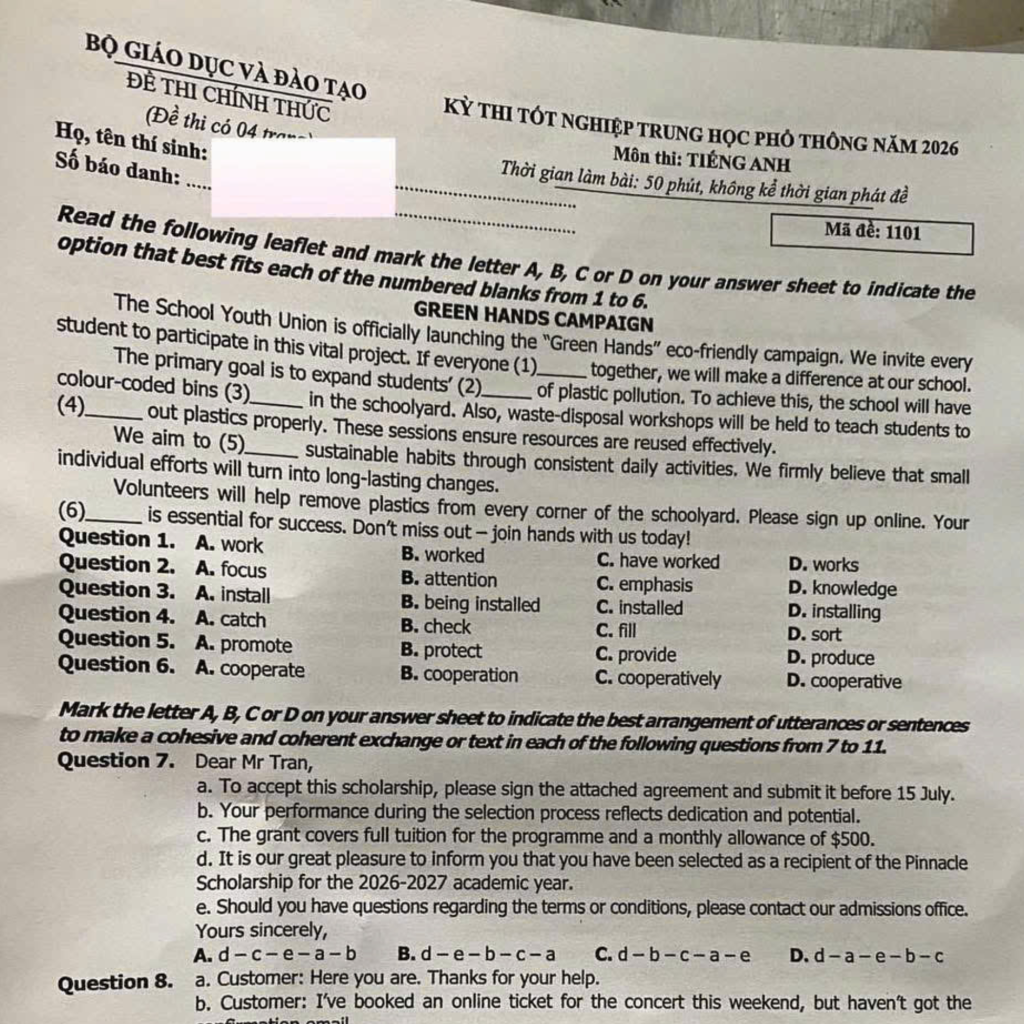
Đáp án đề thi Tiếng Anh Tốt nghiệp THPT 2026 đang được rất nhiều học sinh và phụ huynh tìm kiếm ngay sau khi kỳ thi kết thúc. Để giúp thí sinh nhanh chóng đối chiếu kết quả và đánh giá bài làm của mình, YOLA cập nhật đề thi chính thức, đáp án tham khảo cùng lời giải chi tiết cho từng câu hỏi trong đề thi Tiếng Anh THPT 2026.
Thông qua phần giải đề từ đội ngũ chuyên môn của YOLA, học sinh không chỉ biết mình làm đúng hay sai mà còn hiểu rõ phương pháp xử lý từng dạng bài, những điểm dễ nhầm lẫn và các kiến thức trọng tâm xuất hiện trong đề thi năm nay.
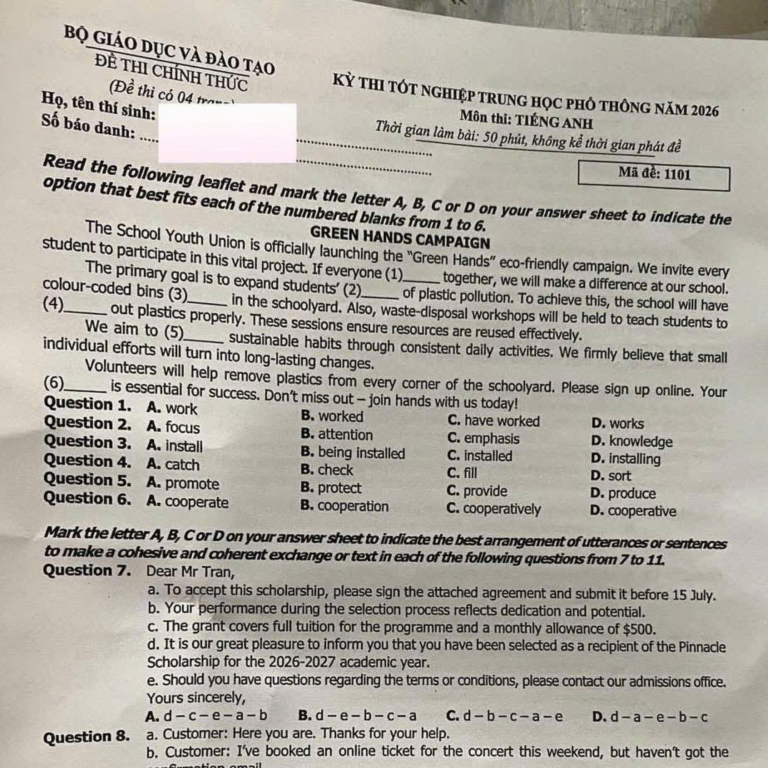
| BỘ GIÁO DỤC VÀ ĐÀO TẠO
ĐỀ THI CHÍNH THỨC (Đề thi có 04 trang) |
KỲ THI TỐT NGHIỆP TRUNG HỌC PHỔ THÔNG NĂM 2026
Môn thi: TIẾNG ANH Thời gian làm bài: 50 phút, không kể thời gian phát đề |
Mã đề: 1101
Read the following leaflet and mark the letter A, B, C or D on your answer sheet to indicate the option that best fits each of the numbered blanks from 1 to 6.
GREEN HANDS CAMPAIGN
The School Youth Union is officially launching the “Green Hands” eco-friendly campaign. We invite every student to participate in this vital project. If everyone (1)_______ together, we will make a difference at our school.
The primary goal is to expand students’ (2)_______ of plastic pollution. To achieve this, the school will have colour-coded bins (3)_______ in the schoolyard. Also, waste-disposal workshops will be held to teach students to (4)_______ out plastics properly. These sessions ensure resources are reused effectively.
We aim to (5)_______ sustainable habits through consistent daily activities. We firmly believe that small individual efforts will turn into long-lasting changes.
Volunteers will help remove plastics from every corner of the schoolyard. Please sign up online. Your (6)_______ is essential for success. Don’t miss out – join hands with us today!
Question 1.
- work
- worked
- have worked
- works
➤ Đáp án: D (works).
Câu điều kiện loại 1: mệnh đề “if” dùng thì hiện tại đơn; “everyone” là chủ ngữ số ít nên động từ thêm -s → “If everyone works together, we will make a difference…”.
Question 2.
- focus
- attention
- emphasis
- knowledge
➤ Đáp án: D (knowledge).
“Expand students’ knowledge of plastic pollution” = mở rộng hiểu biết về ô nhiễm nhựa. Các từ còn lại sai kết hợp từ: “focus on”, “attention to”, “emphasis on” — không đi với “of” và không hợp nghĩa với “expand”.
Question 3.
- install
- being installed
- installed
- installing
➤ Đáp án: C (installed).
Cấu trúc nhờ vả dạng bị động “have + tân ngữ + quá khứ phân từ”: “have colour-coded bins installed” — thùng phân loại được (người khác) lắp đặt.
Question 4.
- catch
- check
- fill
- sort
➤ Đáp án: D (sort).
Cụm động từ “sort out” = phân loại: “sort out plastics properly” — phù hợp ngữ cảnh workshop phân loại rác.
Question 5.
- promote
- protect
- provide
- produce
➤ Đáp án: A (promote).
“Promote sustainable habits” = thúc đẩy/khuyến khích thói quen bền vững. “Protect/provide/produce habits” không hợp nghĩa.
Question 6.
- cooperate
- cooperation
- cooperatively
- cooperative
➤ Đáp án: B (cooperation).
Sau tính từ sở hữu “Your” cần danh từ làm chủ ngữ: “Your cooperation is essential” (sự hợp tác của bạn là thiết yếu).
Mark the letter A, B, C or D on your answer sheet to indicate the best arrangement of utterances or sentences to make a cohesive and coherent exchange or text in each of the following questions from 7 to 11.
Question 7. Dear Mr Tran,
- To accept this scholarship, please sign the attached agreement and submit it before 15 July.
- Your performance during the selection process reflects dedication and potential.
- The grant covers full tuition for the programme and a monthly allowance of $500.
- It is our great pleasure to inform you that you have been selected as a recipient of the Pinnacle Scholarship for the 2026-2027 academic year.
- Should you have questions regarding the terms or conditions, please contact our admissions office.
Yours sincerely,
- d – c – e – a – b
- d – e – b – c – a
- d – b – c – a – e
- d – a – e – b – c
➤ Đáp án: C (d – b – c – a – e).
Thư báo trúng tuyển học bổng: (d) thông báo tin vui được chọn → (b) lý do: thành tích thể hiện sự tận tâm và tiềm năng → (c) quyền lợi: học phí + trợ cấp $500/tháng → (a) việc cần làm: ký và nộp trước 15/7 → (e) câu kết: có thắc mắc thì liên hệ phòng tuyển sinh.
Question 8.
- Customer: Here you are. Thanks for your help.
- Customer: I’ve booked an online ticket for the concert this weekend, but haven’t got the confirmation email.
- Assistant: Please show me the receipt and I’ll check it immediately.
- b – a – c
- a – b – c
- b – c – a
- a – c – b
➤ Đáp án: C (b – c – a).
(b) khách nêu vấn đề: đã đặt vé nhưng chưa nhận email xác nhận → (c) nhân viên yêu cầu xem biên lai để kiểm tra → (a) “Here you are” (khách đưa biên lai) + cảm ơn. “Here you are” chỉ hợp lý sau khi có yêu cầu đưa biên lai.
Question 9.
- The convenience, however, carries inherent risks, because every connected device is a potential entry point for hackers to steal sensitive data.
- Smart homes have become essential features of modern life, transforming how individuals manage their domestic environments efficiently.
- The integrated systems offer convenience, such as turning off the oven from afar or locking doors with a single smartphone tap.
- Anyone investing in smart hardware should carefully weigh the appeal of automation against the time and care required to keep a home network secure.
- A poorly updated router or a default password left unchanged has, in several recent reported cases, allowed strangers to listen in on private family conversations.
- e – d – c – a – b
- c – a – d – b – e
- b – c – a – e – d
- d – e – b – c – a
➤ Đáp án: C (b – c – a – e – d).
(b) giới thiệu chủ đề nhà thông minh → (c) lợi ích: “offer convenience…” → (a) “The convenience, however, carries inherent risks” — lặp lại từ “convenience” của (c) và chuyển sang rủi ro → (e) ví dụ cụ thể về rủi ro (router không cập nhật, mật khẩu mặc định) → (d) kết luận: cân nhắc giữa tiện ích và bảo mật.
Question 10.
- Celine: Why do you say so?
- Celine: I’ve been considering taking a gap year. What’s your view?
- Celine: Thanks. I’ll think about it.
- Steward: The thing is, your studies won’t be interrupted.
- Steward: If I were you, I would go to university right after graduating from high school.
- b – e – a – d – c
- b – d – a – e – c
- a – d – b – e – c
- a – e – b – d – c
➤ Đáp án: A (b – e – a – d – c).
(b) Celine nêu ý định gap year và hỏi ý kiến → (e) Steward khuyên nên vào đại học ngay → (a) Celine hỏi lý do “Why do you say so?” → (d) Steward giải thích “The thing is, your studies won’t be interrupted” → (c) Celine cảm ơn và nói sẽ suy nghĩ.
Question 11.
- Early data from the first quarter revealed a fifteen percent reduction in peak-hour delays and noticeably cleaner air across central wards.
- Motorists entering the central zone had to pay a fee, with the generated revenue allocated for cycle lanes and bus routes.
- Years of unchecked expansion of private vehicle ownership had rendered the commute in Stoneville the slowest in the region.
- The encouraging outcomes suggested that the scheme would be expanded to other districts.
- The city authorities implemented a simple yet controversial intervention: charging a congestion fee.
- b – a – d – e – c
- c – e – b – a – d
- e – b – d – c – a
- a – e – d – c – b
➤ Đáp án: B (c – e – b – a – d).
Mạch vấn đề – giải pháp – kết quả: (c) bối cảnh: giao thông chậm nhất vùng do xe cá nhân tăng không kiểm soát → (e) chính quyền can thiệp: thu phí tắc nghẽn → (b) chi tiết triển khai: tài xế vào trung tâm trả phí, tiền dùng cho làn xe đạp và xe buýt → (a) kết quả: giảm 15% chậm trễ giờ cao điểm, không khí sạch hơn → (d) hệ quả: mở rộng sang các quận khác.
Read the following passage and mark the letter A, B, C or D on your answer sheet to indicate the option that best fits each of the numbered blanks from 12 to 16.
Among the many paradoxes surrounding money, one deserves particular attention: the wealth that truly counts is precisely the wealth you cannot observe. When a sleek Lamborghini glides past, it is normal (12)_______. Closer inspection often tells a different story. A large number of those who drive luxury vehicles are, in fact, only modest earners (13)_______ to the privilege of being seen in such a car. It is uncertain to say whether someone driving a car worth one hundred thousand pounds is affluent. Yet the certain thing is that they have one hundred thousand pounds less than they did before they got the car, or one hundred thousand pounds more in debt. (14)_______.
We tend to judge wealth by what we see as visible details are the only evidence we have access to. Nobody walks around displaying a printout of their savings, (15)_______ – handbags, holiday villas, posts on social networks – to decide who is prospering. Contemporary marketing has fed this habit, packaging the illusion of success as a saleable product. (16)_______. It hides in the upgrade declined, the jewellery left in the display case, the watch never bought, the wardrobe never expanded and the business-class seat politely waved away.
In short, wealth is whatever money has not yet been swapped for tangible goods. That is why distinguishing wealthy from rich deserves careful thought; mistaking one for the other has quietly ruined many a budget.
(Adapted from Psychology of Money)
Question 12.
- for concluding that the person must be doing well behind the wheel
- a good conclusion about whoever sits behind the wheel must be
- a good conclusion about the wheel behind which the person must sit
- to conclude that whoever sits behind the wheel must be doing well
➤ Đáp án: D (to conclude that whoever sits behind the wheel must be doing well).
Cấu trúc “it is normal to + V”: “it is normal to conclude that whoever sits behind the wheel must be doing well” (bình thường khi kết luận rằng người ngồi sau vô lăng hẳn đang ăn nên làm ra).
➤ Loại câu sai
A sai cấu trúc (“normal for concluding”); B, C lộn xộn về ngữ pháp.
Question 13.
- who have committed a disproportionate share of their monthly pay
- a disproportionate share of whose monthly pay is committed
- whose monthly pay is disproportionately committed to sharing
- who are committed to sharing their monthly pay disproportionately
➤ Đáp án: A (who have committed a disproportionate share of their monthly pay).
Mệnh đề quan hệ “who” bổ nghĩa cho “modest earners”; “commit sth to sth” = dành (tiền) cho: “earners who have committed a disproportionate share of their monthly pay to the privilege of being seen in such a car” — khớp với “to the privilege” có sẵn trong bài.
➤ Loại câu sai
- a disproportionate share of whose monthly pay is committed — Cấu trúc đảo kiểu “a share of whose…” (danh từ + of whose + danh từ) chỉ dùng được trong mệnh đề quan hệ không xác định, tức là bắt buộc phải có dấu phẩy ngăn cách: “…modest earners, a disproportionate share of whose monthly pay is committed to…”. Trong đề không có dấu phẩy trước chỗ trống, nên ghép vào sẽ tạo ra câu sai ngữ pháp — “earners a disproportionate share of whose…”.
- whose monthly pay is disproportionately committed to sharing — Phương án này đã tự đóng cấu trúc lại bằng “committed to sharing” (commit to + V-ing), nên cụm “to the privilege” phía sau bị bỏ rơi, không còn vai trò ngữ pháp nào trong câu — ghép vào sẽ thành “committed to sharing to the privilege”, hai cụm “to” chồng lên nhau vô nghĩa. Về nghĩa cũng sai: “sharing” (chia sẻ tiền lương) hoàn toàn không liên quan — họ chi tiền cho đặc quyền, chứ không “chia sẻ” lương cho ai cả.
- who are committed to sharing their monthly pay disproportionately — Sai cả collocation lẫn nghĩa. “Be committed to + V-ing” nghĩa là tận tâm/cam kết với việc gì (như “committed to teaching”) — khác hẳn “commit money to something” là dành tiền cho cái gì.
Question 14.
- You know that it is beyond nothing at all
- Beyond your knowledge, that is nothing
- Beyond that, you know nothing at all
- Beyond that, nothing is unknown to you
“Yet the certain thing is that they have one hundred thousand pounds less than they did before they got the car, or one hundred thousand pounds more in debt. (14)_______.”
➤ Đáp án: C (Beyond that, you know nothing at all). “That” ở đây thay cho “the certain thing” vừa nêu.
Mạch ý: cả đoạn nhấn mạnh ta không thể biết người lái xe sang có giàu thật không (“It is uncertain to say whether someone driving a car worth one hundred thousand pounds is affluent”); điều duy nhất chắc chắn là họ vừa mất/nợ thêm 100.000 bảng (“Yet the certain thing is that they have one hundred thousand pounds less than they did before they got the car, or one hundred thousand pounds more in debt”). Vậy chỗ trống cần chốt phải là C- (Beyond that, you know nothing at all) ngoài sự thật đó ra, bạn không biết gì cả.
➤ Loại câu sai
- You know that it is beyond nothing at all — Câu này vô nghĩa về cú pháp lẫn ngữ nghĩa: “beyond nothing at all” (vượt ra ngoài… không gì cả?) không phải cụm tiếng Anh có nghĩa.
- Beyond your knowledge, that is nothing — Đảo nghĩa hoàn toàn: “that is nothing” nói rằng sự thật kia chẳng có giá trị gì, trong khi đoạn văn khẳng định đó là điều chắc chắn duy nhất (“the certain thing”). Cụm trạng ngữ “Beyond your knowledge” đứng đầu câu cũng lơ lửng, không nối được với ý trước.
- Beyond that, nothing is unknown to you — Bẫy tinh vi nhất: mở đầu giống hệt đáp án đúng (“Beyond that”), nhưng vế sau là phủ định kép: “nothing is unknown” => mọi thứ đều được biết → nghĩa ngược 180 độ với luận điểm trung tâm “the wealth that truly counts is precisely the wealth you cannot observed”.
Question 15.
- so we instead rely on their outward appearances
- instead they rely on the appearances on the outside
- instead of their reliable outward appearances
- yet they appear reliable on the outside instead
“Nobody walks around displaying a printout of their savings, (15)_______ – handbags, holiday villas, posts on social networks – to decide who is prospering.”
➤ Đáp án: A (so we instead rely on their outward appearances).
Chỗ trống bị “kẹp” giữa hai ràng buộc: (1) chuỗi liệt kê sau dấu gạch (túi xách, biệt thự, bài đăng mạng xã hội) cần một danh từ khớp nghĩa để giải thích — đó phải là “outward appearances” (vẻ bề ngoài); (2) cụm mục đích “to decide who is prospering” cần một chủ thể đánh giá — chính là “we” (người quan sát) đã xuất hiện ở câu mở đoạn “We tend to judge wealth by what we see”. Chỉ A thỏa cả hai: “so” thể hiện quan hệ nhân quả (vì không ai khoe sao kê → nên ta đành dựa vào vẻ ngoài).
➤ Loại câu sai
- instead they rely on the appearances on the outside — Sai quy chiếu đại từ: “they” ngữ pháp sẽ trỏ về chủ ngữ câu trước (“Nobody”/người giàu), nhưng người dựa vào vẻ ngoài để phán đoán ai đang phất phải là người quan sát, không phải bản thân người giàu. Ngoài ra, nối hai mệnh đề độc lập chỉ bằng dấu phẩy + “instead” tạo lỗi comma splice — “instead” là trạng từ, không phải liên từ, không thay được “so”.
- instead of their reliable outward appearances — Hai lỗi chồng nhau. Thứ nhất, “instead of + danh từ” biến cả cụm thành giới ngữ phụ thuộc, khiến câu mất mệnh đề chính — cụm to infinitive “to decide who is prospering” phía sau không còn động từ chính nào để bám vào, làm gãy cấu trúc câu. Thứ hai, tính từ “reliable” phản lại luận điểm của bài: vẻ ngoài không hề đáng tin cậy, nó chỉ là bằng chứng duy nhất ta tiếp cận được (“the only evidence we have access to”) — khác xa “bằng chứng đáng tin”.
- yet they appear reliable on the outside instead — Phương án này không có danh từ nào (kiểu “appearances”) để chuỗi liệt kê “handbags, holiday villas…” bổ nghĩa, và cụm to infinitive “to decide who is prospering” không hợp nghĩa với động từ chính “appear”.
Question 16.
- Indeed, wealth in reality is advertised as the refusal of authenticity itself
- However, the reality is that authentic wealth refuses to advertise itself
- Real wealth itself, in reality, is advertised to refuse to be authentic
- Authentic advertisements are, therefore, the refusal of real wealth itself
“Contemporary marketing has fed this habit, packaging the illusion of success as a saleable product. (16)_______. It hides in the upgrade declined, the jewellery left in the display case…”
➤ Đáp án: B (However, the reality is that authentic wealth refuses to advertise itself).
Câu trước: marketing “đóng gói ảo ảnh thành công thành sản phẩm”; câu sau: “It hides in the upgrade declined…”. Chỗ trống cần ý tương phản: “However, the reality is that authentic wealth refuses to advertise itself” — của cải đích thực không phô trương; “It” ở câu sau thay cho “authentic wealth”.
➤ Loại câu sai
- Indeed, wealth in reality is advertised as the refusal of authenticity itself — Sai từ nối: “Indeed” báo hiệu củng cố/tiếp nối ý trước, trong khi mạch văn cần cú bẻ lái tương phản. Nghĩa cũng tự mâu thuẫn với câu sau: nếu của cải “is advertised” (được quảng bá) thì không thể “hides” (ẩn mình) ở câu kế tiếp.
- Real wealth itself, in reality, is advertised to refuse to be authentic — Chuỗi “is advertised to refuse to be authentic” là ba động từ móc nối vô nghĩa (được quảng cáo để từ chối trở nên chân thực?). Giống A, dạng bị động “is advertised” đối chọi trực tiếp với “It hides” ngay sau.
- Authentic advertisements are, therefore, the refusal of real wealth itself — Hai lỗi: (1) “therefore” báo quan hệ nhân quả không tồn tại ở trong đoạn; (2) chủ ngữ bị tráo thành “advertisements” — danh từ số nhiều, nên không khớp với “It” ở câu sau vốn là đại từ số ít;
Read the passage and mark the letter A, B, C or D on your answer sheet to indicate the best answer to each of the following questions from 17 to 26.
It is important to stress that environmental services have costs, even when they are produced without any human input. All costs ought to be measured as opportunity costs. The opportunity cost for environmental services is the net benefit forgone because the resources providing the service can no longer be used in the next most beneficial way. Resources are not free if they can be put to alternative uses.
Consider a stretch of river that can be used either for white-water canoeing or for electric power generation. Because the dam that generates the power would flood the rapids, the two uses are incompatible. The opportunity cost of saving the river for white-water canoeing is the net benefit taken out – after accounting for the cost of generation and distribution – for electricity. Conversely, the opportunity cost of building the dam is everything the unspoiled river would have produced: the recreation, the wildlife, the scenery, and whatever value future generations might place upon experiencing the rapids themselves.
This insight has far-reaching implications for development policy. [I] Many decisions that appear at first to be costless choices in favour of growth turn out, on closer inspection, to be choices against something else. [II] Cutting down a forest for cropland is not free; it is paid for in carbon storage, biodiversity, and the regulating services the forest performed silently. [III] Diverting a river to irrigate fields is not free; the price is whatever the river was doing before the diversion. [IV] Even leaving land untouched is not free, for the income that intensive use might have generated is traded off as well.
Economic development, in this view, is never simply a question of whether a project yields a positive return. It is a question of whether the return exceeds the value of what must be relinquished. Policies that recognise this – by attaching prices to scarce environmental services, or by requiring decision-makers to weigh both sides of the account – do not stand against development. They insist that the development chosen be worth what it truly costs. The danger lies not in counting too much, but in counting too little.
(Adapted from Environmental Economics and Policy)
Question 17. The word forgone in paragraph 1 is closest in meaning to _______.
- given up
- ended up
- filled up
- made up
➤ Đáp án: A (given up).
“Forgone” = bị từ bỏ, bị hy sinh ≈ “given up”: lợi ích ròng bị từ bỏ vì tài nguyên không còn dùng được cho phương án tốt thứ hai.
Question 18. According to paragraph 1, the costs of environmental services are _______.
- calculated based on the direct financial input provided for natural resources
- determined by the market value of the natural resources themselves
- insignificant as these services require almost no human labour to produce
- present whether or not human effort is involved in creating these services
Đoạn 1
“It is important to stress that environmental services have costs, even when they are produced without any human input. All costs ought to be measured as opportunity costs. The opportunity cost for environmental services is the net benefit forgone because the resources providing the service can no longer be used in the next most beneficial way. Resources are not free if they can be put to alternative uses”
➤ Đáp án: D (present whether or not human effort is involved in creating these services).
Đoạn 1: “environmental services have costs, even when they are produced without any human input” — chi phí tồn tại dù có hay không có công sức con người, khớp hoàn toàn với D . Các paraphrase bao gồm “have costs” ↔ “present” (tồn tại) và “without any human input” ↔ “whether or not human effort is involved”,
➤ Loại câu sai
A, B — Không được đề cập trong đoạn 1.
- insignificant as these services require almost no human labour to produce — Ngược hoàn toàn luận điểm trung tâm của đoạn. Lập luận “không tốn công sức → chi phí không đáng kể” nghe rất hợp trực giác, và đó chính xác là quan niệm sai mà tác giả viết cả đoạn để bác bỏ: “environmental services have costs, even when produced without any human input” + “Resources are not free if they can be put to alternative uses”.
Question 19. Which of the following is NOT implied in paragraph 2?
- Hydroelectric generation and white-water canoeing cannot coexist on the same stretch of river.
- The opportunity cost of the dam construction includes intangible benefits that are sacrificed.
- Recreational activities and power generation impose equal environmental burdens on the river.
- The intrinsic value attached to the river may extend beyond its potential use for hydroelectric generation.
Đoạn 2
“Consider a stretch of river that can be used either for white-water canoeing or for electric power generation. Because the dam that generates the power would flood the rapids, the two uses are incompatible. The opportunity cost of saving the river for white-water canoeing is the net benefit taken out – after accounting for the cost of generation and distribution – for electricity. Conversely, the opportunity cost of building the dam is everything the unspoiled river would have produced: the recreation, the wildlife, the scenery, and whatever value future generations might place upon experiencing the rapids themselves.”
➤ Đáp án: C (Recreational activities and power generation impose equal environmental burdens on the river).
Đoạn 2 chỉ làm một việc: trình bày chi phí cơ hội hai chiều — giữ sông để chèo thuyền thì mất lợi ích điện năng, xây đập thì mất mọi thứ dòng sông nguyên sơ mang lại. Tuyệt nhiên không có câu nào so sánh mức độ gánh nặng môi trường của hai hoạt động, càng không kết luận chúng “ngang nhau” (“equal”). C là kiểu nhiễu kinh điển của dạng NOT: tái sử dụng toàn từ ngữ có thật trong bài (recreational, power generation, river) rồi cấy vào một quan hệ so sánh bài chưa từng phát biểu. Học sinh dò từ khóa sẽ thấy “câu nào cũng quen mắt” và bỏ qua chính phương án cần chọn. Thậm chí xét logic, bài còn gợi ý điều ngược lại: xây đập “would flood the rapids” — tác động làm thay đổi hẳn dòng sông, khó mà “ngang” với chèo thuyền.
➤ Loại câu sai
- Hydroelectric generation and white-water canoeing cannot coexist on the same stretch of river — Được ngụ ý từ hai câu: “Consider a stretch of river that can be used either for white-water canoeing or for electric power generation. Because the dam that generates the power would flood the rapids, the two uses are incompatible”.
- The opportunity cost of the dam construction includes intangible benefits that are sacrificed — Được ngụ ý từ câu cuối đoạn 2: “Conversely, the opportunity cost of building the dam is everything the unspoiled river would have produced: the recreation, the wildlife, the scenery, and whatever value future generations might place upon experiencing the rapids themselves” → cảnh quan và giá trị mà thế hệ tương lai gán cho trải nghiệm đều là lợi ích vô hình (intangible), không quy được ra tiền trực tiếp.
- The intrinsic value attached to the river may extend beyond its potential use for hydroelectric generation — Ngụ ý từ câu cuối: dòng sông nguyên sơ “would have produced” giải trí, động vật hoang dã, cảnh quan, giá trị cho thế hệ sau — tức giá trị của nó vượt ra ngoài vai trò phát điện. Cụm “everything the unspoiled river would have produced” là bằng chứng then chốt.
Question 20. Where in paragraph 3 does the following sentence best fit?
Such hidden costs become apparent only when one pauses to consider what nature was quietly doing on its own.
- [III]
- [II]
- [IV]
- [I]
Đoạn 3.
“This insight has far-reaching implications for development policy. [I] Many decisions that appear at first to be costless choices in favour of growth turn out, on closer inspection, to be choices against something else. [II] Cutting down a forest for cropland is not free; it is paid for in carbon storage, biodiversity, and the regulating services the forest performed silently. [III] Diverting a river to irrigate fields is not free; the price is whatever the river was doing before the diversion. [IV] Even leaving land untouched is not free, for the income that intensive use might have generated is traded off as well.”
➤ Đáp án: B ([II]).
Câu “Such hidden costs become apparent only when one pauses to consider what nature was quietly doing on its own” nên đặt ở [II]: “Such hidden costs” thay thế cho ý câu trước [I] “Many decisions that appear at first to be costless choices in favour of growth turn out, on closer inspection, to be choices against something else” — những quyết định “tưởng như không tốn kém” hóa ra “khi xem xét kỹ” lại đánh đổi thứ khác (“become apparent only when one pauses” tương ứng “on closer inspection”). Các câu sau [II] mở ra chuỗi ví dụ về những gì thiên nhiên “âm thầm làm” (rừng → sông → đất); đặt ở vị trí sau sẽ cắt ngang chuỗi ví dụ song song.
Question 21. Which of the following best summarises paragraph 3?
- Policymakers should take the management of natural resources into consideration.
- Initiatives that are perceived as harmless may actually involve underlying sacrifices.
- Long-term ecological balance usually takes precedence over immediate financial gain.
- Economic growth schemes should be halted once ecological disruption is detected.
Đoạn 3.
“This insight has far-reaching implications for development policy. [I] Many decisions that appear at first to be costless choices in favour of growth turn out, on closer inspection, to be choices against something else. [II] Cutting down a forest for cropland is not free; it is paid for in carbon storage, biodiversity, and the regulating services the forest performed silently. [III] Diverting a river to irrigate fields is not free; the price is whatever the river was doing before the diversion. [IV] Even leaving land untouched is not free, for the income that intensive use might have generated is traded off as well.”
➤ Đáp án: B (Initiatives that are perceived as harmless may actually involve underlying sacrifices).
Đoạn 3: những lựa chọn tưởng vô hại/không tốn kém (phá rừng, nắn sông, kể cả để đất hoang) thực ra đều có cái giá ngầm → “Initiatives that are perceived as harmless may actually involve underlying sacrifices.”
➤ Loại câu sai
C, D — Không có trong đoạn.
- Policymakers should take the management of natural resources into consideration — Sai vì quá rộng và lệch trọng tâm. Đoạn 3 không đưa ra khuyến nghị hành động cho nhà hoạch định chính sách; nó đang chứng minh một nhận định thực tế: các lựa chọn tưởng miễn phí đều có giá ngầm. “Management of natural resources” cũng là cách gói chung chung đến mức câu này có thể tóm tắt cho gần như bất kỳ đoạn nào trong bài — dấu hiệu nhận biết kinh điển của phương án nhiễu “đúng nhưng vô thưởng vô phạt”. Một bản tóm tắt tốt phải loại trừ được các đoạn khác.
Question 22. The word They in paragraph 4 refers to _______.
- services
- policies
- prices
- sides
Đoạn 4.
“Economic development, in this view, is never simply a question of whether a project yields a positive return. It is a question of whether the return exceeds the value of what must be relinquished. Policies that recognise this – by attaching prices to scarce environmental services, or by requiring decision-makers to weigh both sides of the account – do not stand against development. They insist that the development chosen be worth what it truly costs. The danger lies not in counting too much, but in counting too little.”
➤ Đáp án: B (policies).
“Policies that recognise this… do not stand against development. They insist that the development chosen be worth what it truly costs.” — “They” thay cho chủ ngữ “Policies” của câu trước; chỉ “policies” (chính sách) khi ráp vào thay cho “They” mới có thể “insist” đòi hỏi phát triển phải xứng đáng với chi phí (“that the development chosen be worth what it truly costs”).
Question 23. What conclusion can be drawn from paragraph 4?
- Deducting the hidden costs is obligatory after a project claims to have a positive return.
- Regulations pricing natural resources are inherently harmful to growth.
- Damage caused by intentional ignorance regarding environmental costs is permanent.
- Considering opportunity costs ensures that development is truly justified.
Đoạn 4.
“Economic development, in this view, is never simply a question of whether a project yields a positive return. It is a question of whether the return exceeds the value of what must be relinquished. Policies that recognise this – by attaching prices to scarce environmental services, or by requiring decision-makers to weigh both sides of the account – do not stand against development. They insist that the development chosen be worth what it truly costs. The danger lies not in counting too much, but in counting too little”
➤ Đáp án: D (Considering opportunity costs ensures that development is truly justified).
Đoạn 4 có các mắt xích lập luận sau: (1) phát triển không chỉ là lợi nhuận dương mà lợi nhuận phải “exceeds the value of what must be relinquished” — giá trị mang lại phải cao hơn thứ bị bỏ đi; (2) chính sách tốt phải đòi hỏi “the development chosen be worth what it truly costs” — sự phát triển phải tương xứng với chi phí tạo ra nó. Xâu chuỗi lại, ý đoạn 4 ứng với D (chỉ khi cân nhắc chi phí cơ hội, ta mới biết một dự án phát triển có thực sự xứng đáng hay không).
Question 24. Which of the following is true according to the passage?
- Opportunity costs are determined by the going rate for environmental services.
- Financial gain is the primary criterion for evaluating development projects.
- The true value of a project is measured not merely by its economic benefits.
- Preserving land in its natural state is economically sound as it consumes no resources.
➤ Đáp án: C (The true value of a project is measured not merely by its economic benefits).
Dạng “true according to the passage” quét toàn bài — bốn phương án cố tình lấy chất liệu từ các đoạn khác nhau, buộc học sinh định vị lại từng câu. Đáp án C (giá trị thật của một dự án không chỉ được đo bằng lợi ích kinh tế) là paraphrase của hai câu mở đoạn 4: “never simply a question of whether a project yields a positive return… whether the return exceeds the value of what must be relinquished” — giá trị thật của dự án phải tính cả những gì bị hy sinh.
➤ Loại câu sai
- Opportunity costs are determined by the going rate for environmental services — Sai định nghĩa gốc ở đoạn 1: chi phí cơ hội là “the net benefit forgone because the resources… can no longer be used in the next most beneficial way” — được xác định bởi lợi ích của phương án thay thế bị bỏ lỡ, không phải bởi “going rate” (mức giá thị trường hiện hành).
- Financial gain is the primary criterion for evaluating development projects — Mâu thuẫn trực diện với luận điểm trung tâm: cả bài được viết ra để bác bỏ chính quan niệm này (“never simply a question of whether a project yields a positive return”).
- Preserving land in its natural state is economically sound as it consumes no resources — Bị bác bỏ bằng nguyên văn ở đoạn 3, câu [IV]: “Even leaving land untouched is not free, for the income that intensive use might have generated is traded off” — đất để hoang vẫn có chi phí cơ hội là khoản thu nhập bỏ lỡ.
Question 25. Which of the following can be inferred from the passage?
- Policies that price environmental services are intended to restrict the scope of economic development.
- The benefits of industrial development generally exceed the value of preserved environmental services.
- Projects are forced to compensate for the economic losses in return for environmental preservation.
- The net gains produced by development projects overlooking opportunity costs tend to be overestimated.
Đoạn 4 là đoạn quan trọng cho câu này.
“Economic development, in this view, is never simply a question of whether a project yields a positive return. It is a question of whether the return exceeds the value of what must be relinquished. Policies that recognise this – by attaching prices to scarce environmental services, or by requiring decision-makers to weigh both sides of the account – do not stand against development. They insist that the development chosen be worth what it truly costs. The danger lies not in counting too much, but in counting too little”
➤ Đáp án: D (The net gains produced by development projects overlooking opportunity costs tend to be overestimated).-> Lợi ích ròng của dự án thường bị thổi phồng do bỏ qua chi phí cơ hội
Đáp án này suy ra từ câu cuối bài: “The danger lies not in counting too much, but in counting too little” (Nguy hiểm không nằm ở tính dư mà là ở tính thiếu)
Chuỗi suy luận là : dự án bỏ qua chi phí cơ hội = “tính thiếu” phần bị hy sinh → lợi ích ròng trên giấy chỉ trừ các chi phí nhìn thấy → con số đó lớn hơn lợi ích ròng thật → tức là bị thổi phồng. Đó chính là Đáp án D
➤ Loại câu sai
- Policies that price environmental services are intended to restrict the scope of economic development — Sai vì đoạn 4 khẳng định ngược lại: các chính sách này “do not stand against development” và chỉ đòi hỏi “the development chosen be worth what it truly costs” — tức mục tiêu là sàng lọc chất lượng quyết định, không phải thu hẹp quy mô phát triển.
- The benefits of industrial development generally exceed the value of preserved environmental services — Sai vì quá tổng quát so với ý của đoạn 4. Toàn bài chỉ nói phải đặt hai vế “development” và “preservation” lên bàn cân từng trường hợp (“Policies that recognise this – by attaching prices to scarce environmental services, or by requiring decision-makers to weigh both sides of the account”), tuyệt nhiên không kết luận vế nào “generally” thắng.
- Projects are forced to compensate for the economic losses in return for environmental preservation — Sai vì cơ chế bồi thường không có trong bài. Hai công cụ chính sách duy nhất được nhắc là định giá dịch vụ môi trường và yêu cầu cân nhắc hai vế — không có dòng nào về việc dự án phải “đền bù thiệt hại kinh tế”.
Question 26. Which of the following would be the best title for the passage?
- Environmental Policies in the Firing Line
- Natural Preservation: Ushering in a New Era
- Development: Factoring in Sacrifices
- Economic Development on the Line
➤ Đáp án: C (Development: Factoring in Sacrifices).
Toàn bài lập luận: phát triển phải tính đến những gì bị hy sinh (chi phí cơ hội) → “Development: Factoring in Sacrifices”.
➤ Loại câu sai
- Environmental Policies in the Firing Line — Sai cả phạm vi lẫn sắc thái. Thành ngữ “in the firing line” nghĩa là đang hứng chỉ trích, bị tấn công — vẽ ra một cuộc tranh cãi mà bài không hề mô tả; ngược lại, đoạn 4 còn bênh vực các chính sách này (“do not stand against development”). Về phạm vi, “environmental policies” chỉ xuất hiện ở đoạn 4 như một ứng dụng của lập luận — lấy nó làm tiêu đề là phóng đại một nhánh ý phụ thành toàn bài, bỏ qua ba đoạn đầu về khái niệm chi phí cơ hội.
- Natural Preservation: Ushering in a New Era — Sai trọng tâm. Bài đọc không cổ vũ bảo tồn — nó nhấn mạnh cả bảo tồn cũng có chi phí cơ hội (“Even leaving land untouched is not free”). Cụm “Ushering in a New Era” (mở ra kỷ nguyên mới) còn mang giọng tuyên ngôn, đại ngôn kiểu quảng cáo — hoàn toàn lạc khỏi văn phong phân tích kinh tế học chừng mực của bài.
- Economic Development on the Line — Bẫy tinh vi nhất vì có chữ “Development” giống đáp án đúng. Nhưng thành ngữ “on the line” nghĩa là đang bị đe dọa, đặt cược, lâm nguy — bài không hề nói phát triển kinh tế đang gặp rủi ro hay bị đặt cược; nó chỉ nói các quyết định phát triển cần được tính đủ chi phí.
Read the following advertisement and mark the letter A, B, C or D on your answer sheet to indicate the option that best fits each of the numbered blanks from 27 to 32.
SUMMER PART-TIME JOBS FOR UNDERGRADUATES
TechWorld Magazine is delighted to announce two IT assistant vacancies up for (27)_______ this summer. The better understanding of STEM you have, (28)_______ likely you are to be selected! Successful applicants will get plenty of hands-on experience, good pay, and access to the local STEM community.
(29)_______, we offer flexible working hours and remote options for those living far away. On top of that, (30)_______ position requires previous experience as new recruits are provided with in-service training sessions.
Applications (31)_______ be submitted to us at [email protected] by 30 June.
Never before has there been such a(n) (32)_______ opportunity to kick-start your career in STEM. Don’t let this chance slip through your fingers – apply today!
Question 27.
- grasp
- gift
- grips
- grabs
“TechWorld Magazine is delighted to announce two IT assistant vacancies up for (27)_______ this summer.”
➤ Đáp án: D (grabs).
Thành ngữ “up for grabs” = đang chờ người giành lấy, sẵn sàng cho mọi ứng viên: “two IT assistant vacancies up for grabs this summer”. Tất cả các đáp án còn lại đều không khớp thành ngữ.
Question 28.
- the most
- most
- more
- the more
“The better understanding of STEM you have, (28)_______ likely you are to be selected!”
➤ Đáp án: D (the more).
Cấu trúc so sánh kép “the + so sánh hơn…, the + so sánh hơn…”: “The better understanding of STEM you have, the more likely you are to be selected.”
➤ Loại câu sai
A, B là so sánh nhất nên không phù hợp; C thiếu “the”.
Question 29.
- Additionally
- Consequently
- Subsequently
- Finally
“Successful applicants will get plenty of hands-on experience, good pay, and access to the local STEM community. (29)_______, we offer flexible working hours and remote options for those living far away.”
➤ Đáp án: A (Additionally).
Câu trước liệt kê quyền lợi; câu này bổ sung thêm quyền lợi (giờ linh hoạt, làm từ xa) → “Additionally” (thêm vào đó).
➤ Loại câu sai
Hai câu quanh chỗ trống (29) không có quan hệ nhân quả (Consequently) hay sắp xếp theo trình tự thời gian (Subsequently/Finally) nên B, C, D sai.
Question 30.
- neither
- both
- none
- either
“On top of that, (30)_______ position requires previous experience as new recruits are provided with in-service training sessions.”
➤ Đáp án: A (neither).
Vế sau của câu “as new recruits are provided with in-service training” cho thấy cả hai vị trí trợ lý mới đều KHÔNG yêu cầu kinh nghiệm → “neither position requires previous experience” (“neither” = cả hai đều không + danh từ số ít) giúp vế trước khớp nghĩa với vế sau và giúp chủ ngữ “neither position” hợp với động từ số ít “requires”.
Question 31.
- ought
- should
- ought not
- should not
“Applications (31)_______ be submitted to us at [email protected] by 30 June.”
➤ Đáp án: B (should).
“Applications should be submitted by 30 June” — “should” + động từ nguyên mẫu “be”.
➤ Loại câu sai
A — “ought” phải có “to” (ought to be).
C, D — Dạng phủ định trái với ngữ cảnh kêu gọi nộp đơn.
Question 32.
- lively
- active
- golden
- private
“Never before has there been such a(n) (32)_______ opportunity to kick-start your career in STEM. Don’t let this chance slip through your fingers – apply today!”
➤ Đáp án: C (golden).
“A golden opportunity” = cơ hội vàng — cụm cố định, hợp với giọng quảng cáo “Never before has there been such a golden opportunity…”.
Read the passage and mark the letter A, B, C or D on your answer sheet to indicate the best answer to each of the following questions from 33 to 40.
For decades, students have been convinced that academic success is largely dependent upon meticulous notetaking. What has changed in recent years is not the importance of the practice but the tools used to perform it. The keyboard has subtly supplanted the pen, and with it, the nature of how information is recorded during a lecture has shifted unbeknownst to students.
Researchers in cognitive psychology have begun to examine what this change has cost learners. In a series of comparative studies, students taking notes by hand consistently outperformed those using laptops on questions that demanded conceptual understanding, even when both groups had access to the same material. The reason, according to the researchers, lies less in the technology itself than in what each method asks of the brain. Typing rewards speed; handwriting forces selection.
The act of writing by hand is slower, and that slowness appears to be its hidden virtue. Unable to capture every word, students are obliged to listen, decide what matters and condense ideas into their own phrasing. This continuous filtering, referred to as encoding by psychologists, turns out to be instrumental in aiding long-term recall. One lecturer summarised the striking contrast after reviewing her students’ work: the laptops, she said, had produced transcripts, while the notebooks had produced understanding.
It would be misleading, of course, to claim that handwriting is inherently superior or that all keyboards undermine learning. Hard-working typists can summarise, while indolent writers can drift. What the research highlights is not a conclusion on devices but a question about effort: which tool, in a given context, asks more of the learner. As a ban on students’ use of laptops in classrooms remains a bone of contention among tertiary institutions, the deeper challenge may be helping students recognise that what feels easier in the moment is not always what serves them best afterwards.
(Adapted from https://www.brookings.edu)
Question 33. In paragraph 1, the writer is _______.
- introducing a recent change in the way students take notes
- challenging a long-held assumption about academic success
- promoting the use of technology in recording lectures
- questioning the significance of notetaking in education
➤ Đáp án: A (introducing a recent change in the way students take notes).
Theo đoạn 1, điều thay đổi không phải tầm quan trọng của việc ghi chép mà là công cụ: “What has changed in recent years is not the importance of the practice but the tools used to perform it. The keyboard has subtly supplanted the pen…” → tác giả giới thiệu một thay đổi gần đây trong cách sinh viên ghi chép.
➤ Loại câu sai
- challenging a long-held assumption about academic success — Bẫy nguy hiểm nhất vì đoạn 1 có nhắc đến một niềm tin lâu đời (“For decades, students have been convinced…”). Nhưng tác giả không hề thách thức niềm tin đó — câu sau khẳng định ngay điều thay đổi “not the importance of the practice”: tầm quan trọng của ghi chép được giữ nguyên, chỉ công cụ là đổi.
- promoting the use of technology in recording lectures — Ngược sắc thái: các từ “subtly supplanted” (lặng lẽ soán chỗ), “shifted unbeknownst to students” (thay đổi mà sinh viên không hay biết) mang giọng cảnh giác, không phải cổ vũ. Toàn bài sau đó còn nghiêng về phía ghi tay.
- questioning the significance of notetaking in education — Cùng lỗi với B, thậm chí bị bác trực tiếp hơn: “not the importance of the practice” — tác giả tuyên bố rõ mình không đặt nghi vấn về tầm quan trọng của ghi chép.
Question 34. The word those in paragraph 2 refers to _______.
- students
- researchers
- studies
- notes
Đoạn 2.
“Researchers in cognitive psychology have begun to examine what this change has cost learners. In a series of comparative studies, students taking notes by hand consistently outperformed those using laptops on questions that demanded conceptual understanding, even when both groups had access to the same material”
➤ Đáp án: A (students).
“Students taking notes by hand consistently outperformed those using laptops” — thay “students” vào “those” là hoàn toàn hợp nghĩa của câu (nhóm sinh viên dùng laptop). Các lựa chọn còn lại thay vào “those” đều không hợp nghĩa.
Question 35. Which of the following best paraphrases the underlined sentence in paragraph 2?
- The modern device, along with the mental requirements of each method for the brain, is responsible for the difference in student performance.
- What explains the difference in student performance is the mental work that each method of notetaking demands, rather than the technology.
- The difference in student performance is attributable to the modern technology instead of the mental work that each method of notetaking requires.
- Regardless of the method of notetaking, the effects on the brain exhibit little difference as long as technology is involved in student performance.
Đoạn 2.
“Researchers in cognitive psychology have begun to examine what this change has cost learners. In a series of comparative studies, students taking notes by hand consistently outperformed those using laptops on questions that demanded conceptual understanding, even when both groups had access to the same material. The reason, according to the researchers, lies less in the technology itself than in what each method asks of the brain. Typing rewards speed; handwriting forces selection.”
➤ Đáp án: B (What explains the difference in student performance is the mental work that each method of notetaking demands, rather than the technology).
Câu gạch chân: nguyên nhân “nằm ở cách tư duy mà mỗi phương pháp đòi hỏi ở não bộ hơn là ở bản thân công nghệ” → ứng với B: điều giải thích sự khác biệt là công việc trí óc mà mỗi cách ghi chép yêu cầu, chứ không phải công nghệ.
➤ Loại câu sai
- The modern device, along with the mental requirements of each method for the brain, is responsible for the difference in student performance — Sai vì quy trách nhiệm cho cả hai yếu tố (cách tư duy và công cụ) ngang nhau, trong khi câu gốc đã xếp hạng rõ: ít ở công nghệ, nhiều ở não bộ.
- The difference in student performance is attributable to the modern technology instead of the mental work that each method of notetaking requires — Sai vì đảo ngược quan hệ của hai yếu tố, nói kết quả có được chủ yếu là nhờ công nghệ chứ không phải do cách tư duy. Đây là ngược hoàn toàn với câu gốc: ít ở công nghệ, nhiều ở cách tư duy.
- Regardless of the method of notetaking, the effects on the brain exhibit little difference as long as technology is involved in student performance — Sai vì phủ nhận sự khác biệt, trái với toàn bộ đoạn 2 (nhóm ghi tay “consistently outperformed” = làm bài tốt hơn nhóm laptop). Câu gốc giải thích vì sao có khác biệt; D nói chẳng có khác biệt gì.
Question 36. The word instrumental in paragraph 3 is OPPOSITE in meaning to _______.
- trivial
- specific
- dramatic
- central
Đoạn 3.
“The act of writing by hand is slower, and that slowness appears to be its hidden virtue. Unable to capture every word, students are obliged to listen, decide what matters and condense ideas into their own phrasing. This continuous filtering, referred to as encoding by psychologists, turns out to be instrumental in aiding long-term recall. One lecturer summarised the striking contrast after reviewing her students’ work: the laptops, she said, had produced transcripts, while the notebooks had produced understanding.”
➤ Đáp án: A (trivial).
“Instrumental” = đóng vai trò quan trọng/then chốt; từ TRÁI nghĩa là “trivial” (không đáng kể). Lưu ý đề hỏi OPPOSITE — D “central” là từ ĐỒNG nghĩa, là bẫy nguy hiểm nhất; B và C không khớp nghĩa câu.
Question 37. The word indolent in paragraph 4 is closest in meaning to _______.
- serious
- lazy
- careful
- active
Đoạn 4.
“It would be misleading, of course, to claim that handwriting is inherently superior or that all keyboards undermine learning. Hard-working typists can summarise, while indolent writers can drift. What the research highlights is not a conclusion on devices but a question about effort: which tool, in a given context, asks more of the learner. As a ban on students’ use of laptops in classrooms remains a bone of contention among tertiary institutions, the deeper challenge may be helping students recognise that what feels easier in the moment is not always what serves them best afterwards.”
➤ Đáp án: B (lazy).
“Indolent” = lười biếng ≈ “lazy” — đối lập với “hard-working typists” ngay trong cùng câu (“Hard-working typists can summarise, while indolent writers can drift”). Liên từ “while” + cấu trúc câu cân xứng báo hiệu tương phản: vế trước là người gõ phím chăm chỉ, vế sau phải là người viết tay lười nhác → B (lazy).
Question 38. Which of the following statements would the writer NOT agree with?
- Handwritten and typed notes led to varied degrees of conceptual understanding.
- The slow speed of writing by hand turns out to be an advantage over typing.
- Students are unaware of the change in notetaking methods in class.
- Universities generally approve of prohibiting laptop use in classrooms.
➤ Đáp án: D (Universities generally approve of prohibiting laptop use in classrooms).
Dạng câu hỏi NOT agree with → loại trừ bằng bằng chứng. Bài viết nói lệnh cấm laptop “remains a bone of contention among tertiary institutions” — vẫn là vấn đề gây tranh cãi giữa các trường, tức là không có sự tán thành chung.
➤ Loại câu sai
- Handwritten and typed notes led to varied degrees of conceptual understanding — Tác giả ĐỒNG Ý với A: đoạn 2 ghi nhận nhóm ghi tay “consistently outperformed” nhóm laptop ở câu hỏi đòi hiểu khái niệm → hai cách ghi chép dẫn đến mức độ hiểu khái niệm khác nhau (“varied degrees of conceptual understanding”).
- The slow speed of writing by hand turns out to be an advantage over typing — Tác giả ĐỒNG Ý với B: đoạn 3 nói thẳng “The act of writing by hand is slower, and that slowness appears to be its hidden virtue” — chậm chính là lợi thế ẩn của viết tay so với gõ phím.
- Students are unaware of the change in notetaking methods in class — Tác giả ĐỒNG Ý với C: đoạn 1 viết sự thay đổi diễn ra “unbeknownst to students” (sinh viên không hề hay biết) — khớp với “Students are unaware of the change”.
Question 39. In which paragraph does the writer mention a cognitive process?
- Paragraph 2
- Paragraph 1
- Paragraph 3
- Paragraph 4
➤ Đáp án: C (Paragraph 3).
Đoạn 3 nêu một quá trình nhận thức (cognitive process) ở câu “This continuous filtering, referred to as encoding by psychologists, turns out to be instrumental in aiding long-term recall” — quá trình lọc này được các nhà tâm lý gọi là quá trình “mã hóa” thông tin giúp ghi nhớ dài hạn.
Question 40. In which paragraph does the writer warn against an overgeneralisation?
- Paragraph 2
- Paragraph 1
- Paragraph 3
- Paragraph 4
➤ Đáp án: D (Paragraph 4).
Ở đoạn 4, tác giả cảnh báo về chuyện khái quát hóa quá mức (warn against an overgeneralisation) qua câu “It would be misleading, of course, to claim that handwriting is inherently superior or that all keyboards undermine learning” — câu này có các dấu hiệu nhận diện của khái quát hóa quá mức: các từ tuyệt đối như “inherently” (vốn dĩ) và “all” (trong mọi trường hợp). Việc khái quát hóa quá mức này được tác giả cảnh báo (warn) là “misleading” (dễ gây hiểu sai lệch).
👉 Tham khảo lộ trình tăng band IELTS hiệu quả. Kiểm tra trình độ MIỄN PHÍ tại đây

 07/09/2026
KIỂM TRA TRÌNH ĐỘ TIẾNG ANH MIỄN PHÍ TẠI YOLA
Chỉ 50 suất mỗi tháng dành cho học viên từ 4 tuổi Con đã học tiếng Anh một thời gian nhưng ba mẹ chưa biết năng lực hiện tại của con đang ở đâu? Con nên bắt đầu từ cấp độ nào? Kỹ năng nào đang tốt và đâu là phần cần được củng cố? […]
 12/06/2026
ĐÁP ÁN & GIẢI THÍCH CHI TIẾT ĐỀ THI TIẾNG ANH TỐT NGHIỆP THPT NĂM 2026
Đáp án đề thi Tiếng Anh Tốt nghiệp THPT 2026 đang được rất nhiều học sinh và phụ huynh tìm kiếm ngay sau khi kỳ thi kết thúc. Để giúp thí sinh nhanh chóng đối chiếu kết quả và đánh giá bài làm của mình, YOLA cập nhật đề thi chính thức, đáp án tham […]
 09/04/2026
RA MẮT KHÓA HÈ 2026: LÀM CHỦ AI, LÀM BẠN VỚI THIÊN NHIÊN
Thế giới đang đứng trước một làn sóng công nghệ chưa từng có với sự trỗi dậy của Trí tuệ nhân tạo (A.I). Nhưng giữa những màn hình kỹ thuật số, liệu chúng ta có đang vô tình để trẻ “ngắt kết nối” với vẻ đẹp của thiên nhiên? 👉 Khóa hè 2026 chính thức […]
 08/04/2026
HỌC IELTS CẤP TỐC CÓ THỰC SỰ HIỆU QUẢ? REVIEW CHI TIẾT KHÓA INTENSIVE TẠI YOLA 2026
“Học cấp tốc là học vẹt”, “Chỉ giải quyết được phần ngọn chứ không có gốc” – Đây là những định kiến phổ biến khiến nhiều sĩ tử e dè trước các khóa luyện thi ngắn hạn. Tuy nhiên, với áp lực nộp hồ sơ xét tuyển đại học và du học năm 2026 ngày […]